Music

Rationale

At Airy Hill we have a clear understanding of the importance of being able to appreciate, respond to, perform and compose music as essential life skills. We strive towards children having a rich appreciation of a wide of musical genres and instruments (including voice), as listeners, composers and performers. This enables them to develop a broad understanding of music as a driver for cultural expression, creativity and community, as well as experience the positivity it can bring to themselves and others.

Aims

Pupils in all years will follow the Kapow primary music curriculum. This provides a structured and progressive scheme of work, which develops children’s skills in singing, playing, listening and composing. Within a topic-based cross-curricular framework, each unit has a specific musical focus. Activities are selected and adapted to match the needs, interests and abilities of all children in the school.

Key Concepts

We focus on the key concepts of: Listening and evaluating, creating sound, notation, improvising and composing and performing-singing and dancing.

Skills Progression

Our curriculum takes children on their journey from EYFS to Year 6. Our Progression of knowledge and skills shows the skills that are taught within each year group and how these skills develop to ensure that attainment targets are securely met by the end of each key stage.

Intent

At Airy Hill it is our intention that first and foremost is to help children to feel that they are musical, and to develop a life-long love of music. We focus on developing the skills, knowledge and understanding that children need in order to become confident performers, composers, and listeners. Our curriculum introduces children to music from all around the world and across generations, teaching children to respect and appreciate the music of all traditions and communities. Children will develop the musical skills of singing, playing tuned and untuned instruments, improvising and composing music, and listening and responding to music. They will develop an understanding of the history and cultural context of the music that they listen to and learn how music can be written down. Through music, our curriculum helps children develop transferable skills such as team-working, leadership, creative thinking, problem-solving, decision-making, and presentation and performance skills. These skills are vital to children’s development as learners and have a wider application in their general lives outside and beyond school. Our curriculum enables pupils to meet the end of key stage attainment targets outlined in the National curriculum and the aims of the scheme align with those in the National curriculum.

Implementation

At Airy Hill we take a holistic approach to music, in which the individual strands below are woven together to create engaging and enriching learning experiences:

  • Listening and evaluating
  • Creating sound
  • Notation
  • Improvising and composing
  • Performing

Each five-lesson unit combines these strands within a cross-curricular topic designed to capture pupils’ imagination and encourage them to explore music enthusiastically. Within our school children will be taught how to sing fluently and expressively, and play tuned and untuned instruments accurately and with control. They will learn to recognise, demonstrate and name the interrelated dimensions of music - pitch, duration, tempo, timbre, structure, texture and dynamics - and use these expressively in their own improvisations and compositions. Our National curriculum coverage shows which of our units cover each of the National curriculum attainment targets as well as each of the strands. Children progress in terms of tackling more complex tasks and doing more simple tasks better, as well as developing understanding and knowledge of the history of music, staff, and other musical notations, the interrelated dimensions of music and more.

Impact

In each lesson, pupils will actively participate in musical activities drawn from a range of styles and traditions, developing their musical skills and their understanding of how music works. Lessons incorporate a range of teaching strategies from independent tasks, paired and group work as well as improvisation and teacher-led performances. Lessons are ‘hands-on’ and incorporate movement and dance elements, as well as making cross curricular links with other areas of learning. Differentiated guidance is available for every lesson to ensure that lessons can be accessed by all pupils and opportunities to stretch pupils’ learning are available when required. 

Music Development Plan

Music development plan summary:
Airy Hill Primary School

Overview

Detail Information
Academic year that this summary covers 2025-2026
Date this summary was published September 2025
Date this summary will be reviewed September 2026
Name of the school music lead Debbie Digby
Name of school leadership team member with responsibility for music (if different) Sam Butters
Name of local music hub North Yorkshire Music Hub
Name of other music education organisation(s) (if partnership in place) Jill Mortimer (Specialist Music Teacher) Bob Butterfield (Specialist Music Teacher) Shirley Smith (Specialist Music Teacher)

At Airy Hill Primary School, we believe that music is a vital part of a broad and balanced curriculum and a powerful tool for supporting children’s wellbeing, confidence, cultural awareness and creativity. Our music provision sits firmly within our UNICEF Rights Respecting ethos and supports several articles of the UN Convention on the Rights of the Child, including:

  • Article 13 – the right to freedom of expression
  • Article 29 – the right to an education that develops children’s talents and abilities
  • Article 31 – the right to participate in cultural and artistic life

We deliver music across three key areas:

  1. Curriculum Music
  2. Extra‑Curricular Music
  3. Enrichment and Musical Experiences

This summary outlines what we offer and how we plan to enhance music education further.

Part A: Curriculum music

All pupils at Airy Hill receive one hour of music per week, every term, in line with national expectations. Each year group also receives half a term of specialist‑led music teaching to supplement curriculum delivery.

Curriculum Structure

We use the KAPOW Music Scheme, ensuring a sequenced and progressive curriculum aligned to the Model Music Curriculum. Pupils engage in a wide range of musical learning experiences designed to build knowledge, technical skill and creativity.

Curriculum Entitlements

Through high‑quality teaching, pupils will:

  • Explore, listen to and appraise music from diverse cultures, traditions and historical periods (Article 31).
  • Develop control and expression using voices, tuned and untuned instruments.
  • Learn how musical notation represents sound.
  • Compose, improvise and arrange music using a range of instruments.
  • Perform to audiences in school and the wider community (Article 13).

Instrumental Development

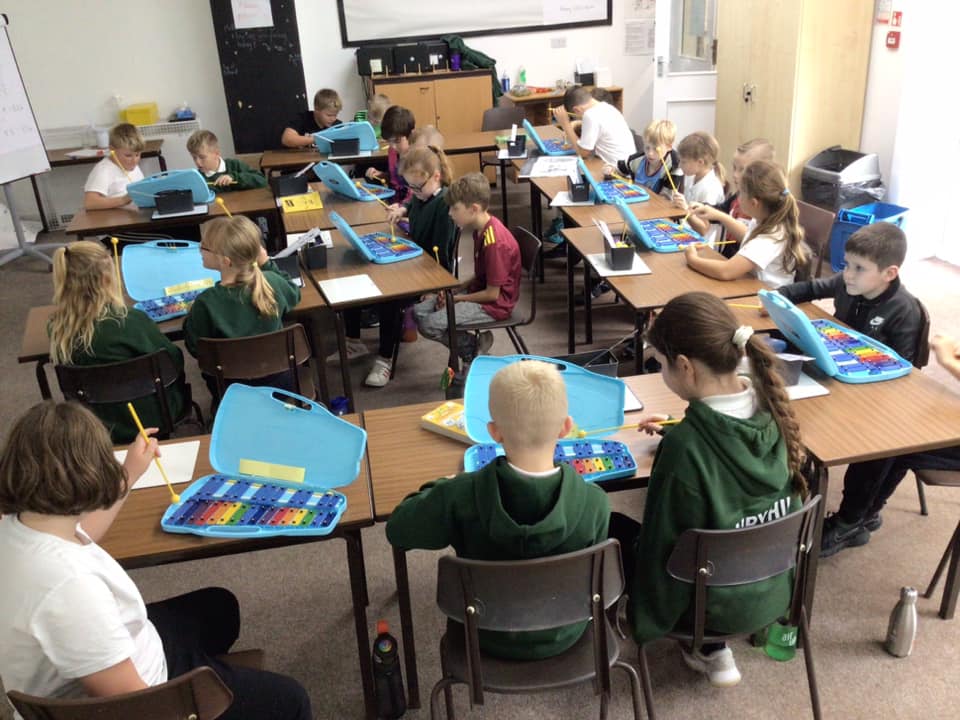
Pupils have the opportunity to learn the glockenspiel through a structured progression model that builds technical proficiency over time.

We also work with three specialist musicians providing:

  • whole‑class or group curriculum support,
  • small‑group instrumental teaching (piano, flute),
  • 1:1 tuition for pupils showing aptitude or interest (Article 29 encourages development of talents).

This ensures that pupils can become proficient on more than one instrument and access expert musical guidance.

Part B: Extra-curricular music

Singing Assembly

A weekly whole‑school singing assembly enables all pupils to develop vocal skills, musicality and collective performance confidence. This supports cultural participation and expression (Article 31).

Peripatetic Instrumental Lessons

Our visiting music teacher offers:

  • Piano tuition
  • Flute tuition
  • 1:1 and small‑group instrumental lessons

These lessons are popular and well‑attended. Disadvantaged pupils are offered fully funded places to ensure equal access (Article 2 – non‑discrimination, Article 31).

Some pupils have progressed to represent the school at the Eskdale Festival of Arts.

Choir / Glee Club

Airy Hill runs a successful year‑round choir led by a specialist musician. Key features include:

  • Regular community performances (care homes, fairs, festivals, museum projects)
  • Participation in local competitions such as the Eskdale Festival of Arts and Whitby Big Sing, with several recent wins
  • Recognition from the Whitby Mayor, who awarded the choir a Mayoral Award for contributions to the community

This club also supports expression, confidence and wellbeing (Articles 13 and 31).

Part C: Musical experiences

We are committed to ensuring all pupils—regardless of background—experience high‑quality musical and cultural events. Many experiences are free, and where costs occur, we work with the PFTA to subsidise access (Article 31).

Planned Events for 2025/26

  • Eskdale Festival of the Arts
  • Eskdale Festival Celebration Concert
  • Year 5/6 Summer Production
  • Whitby Big Sing

Annual Experiences

  • Harvest Festival – whole‑school singing and performance
  • Christmas Production – all pupils take part
  • Pantomime Visit – experiencing live performance
  • Summer Fair Performances – showcasing instrumental learning
  • Choir visits to local care homes, library events, and museum heritage weeks

These opportunities foster cultural engagement, celebration of the arts, and confidence in performance.


In the future


We aim to continue strengthening musical provision across school and the wider trust through:

·         Developing a Trust‑wide music event to celebrate talent across all schools.

·         Expanding the diversity of musical experiences, including music from global cultures and traditions (Article 30 – cultural identity).

·         Enhancing access to a wider range of instruments through resource pooling across schools.

·         Building deeper partnerships with the North Yorkshire Music Hub for CPD, enrichment and performance.


Further information (optional)

Use this space to provide any further information about your school’s music development plan, including links to your local music hub partners, other local music education organisations and contacts.

The Department for Education publishes a guide for parents and young people on how they can get involved in music in and out of school, and where they can go to for support beyond the school.

Your local music hub should also have a local plan for music education in place from September 2024 that should include useful information.

If your school is part of a multi-academy trust with a trust-wide music development plan, you may also want to include a link to any published information on this plan.

We have chosen to use the KAPOW curriculum for music as KAPOW has been designed by music and primary trained experts. KAPOW meets all the requirements of the national curriculum. KAPOW is sequenced in a logical and spiral curriculum way so knowledge is retained helping pupils to learn and remember more.